
Diode: how it works, with live circuits
A diode lets current flow one way and blocks it the other. Run the circuits below in the DCACLab diode simulator, right in your browser: read the forward drop, turn the diode round, then try a Zener regulator.
The two circuits on this page work without an account. On a computer or tablet the full lab is limited without an account; a free account lets you try it in full first. NGSpice charts need an account; saving needs a plan. Create a free account
Try the diode simulator: forward bias
A 9 V battery drives a silicon diode through 1 kΩ. The voltmeter is across the diode, the ammeter in the loop. The diode points the way current flows, so it is forward biased and conducts.
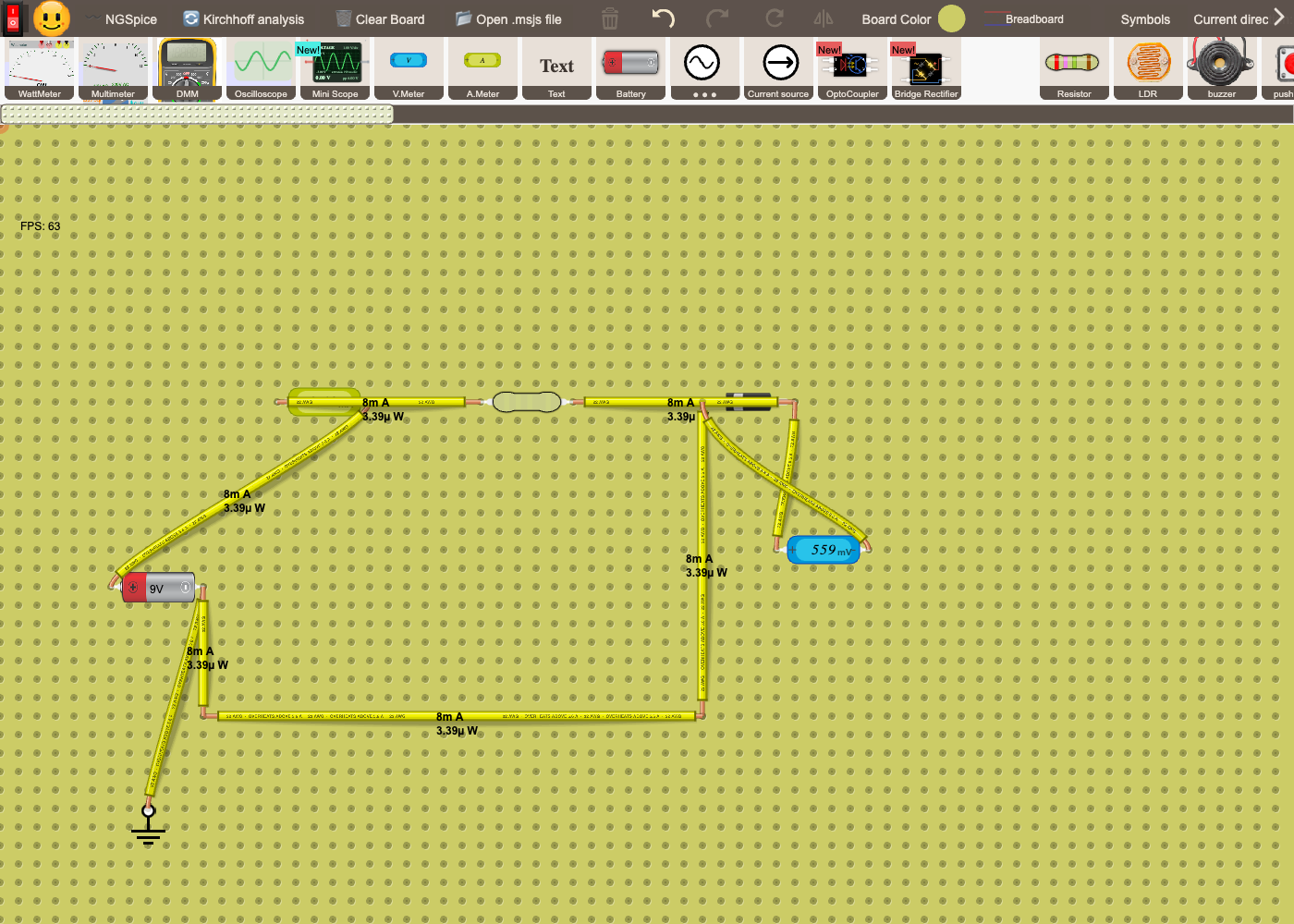
- Read the meters: about 0.56 V across the diode and 8.4 mA in the loop.
- Set the resistor to 100 Ω: the current jumps to about 83 mA, but the drop rises only to about 0.68 V.
- Click the diode and press F, or tick the flip box in its inspector, to turn it round: it blocks, and almost the whole 9 V sits across it.
What is a diode?
A diode is a one-way valve for current. Its two pins are the anode and the cathode: current flows from anode to cathode, and almost none flows back.
- Forward bias: the anode is more positive than the cathode, and the diode conducts.
- Reverse bias: the cathode is more positive, and the diode blocks.
The diode symbol, anode and cathode
The lab draws these symbols in its Symbols view. The triangle points the way current flows, into the bar: the cathode, marked by a band on a real diode. The Zener's bar has bent ends; the LED adds two arrows for its light.
Why a diode drops about 0.7 V
Textbooks round a silicon diode's drop to about 0.7 V, but the lab draws the real curve. Its plain diode is set to about 0.8 V at 1 A, so it drops about 0.44 V at 0.86 mA, 0.56 V at 8.4 mA and 0.68 V at 83 mA.
The current changes a hundred times while the drop changes by less than 0.25 V, so the series resistor sets the current. In the full lab, with NGSpice turned off, you can change the forward voltage in the diode's inspector.
Turned round, the diode is reverse biased: about 8.99 V across it and 0.00 A. In the full lab with NGSpice turned on, the ammeter shows a small reverse current, about 9 µA.
Zener diode and the voltage regulator
A Zener diode conducts in reverse once it reaches its Zener voltage, and holds that voltage. Wired in reverse across a load, with a series resistor, it makes a voltage regulator.
A 12 V battery feeds a 5.6 V Zener through 330 Ω, with a 1 kΩ load across it. The voltmeter reads the output, the ammeter the battery current.
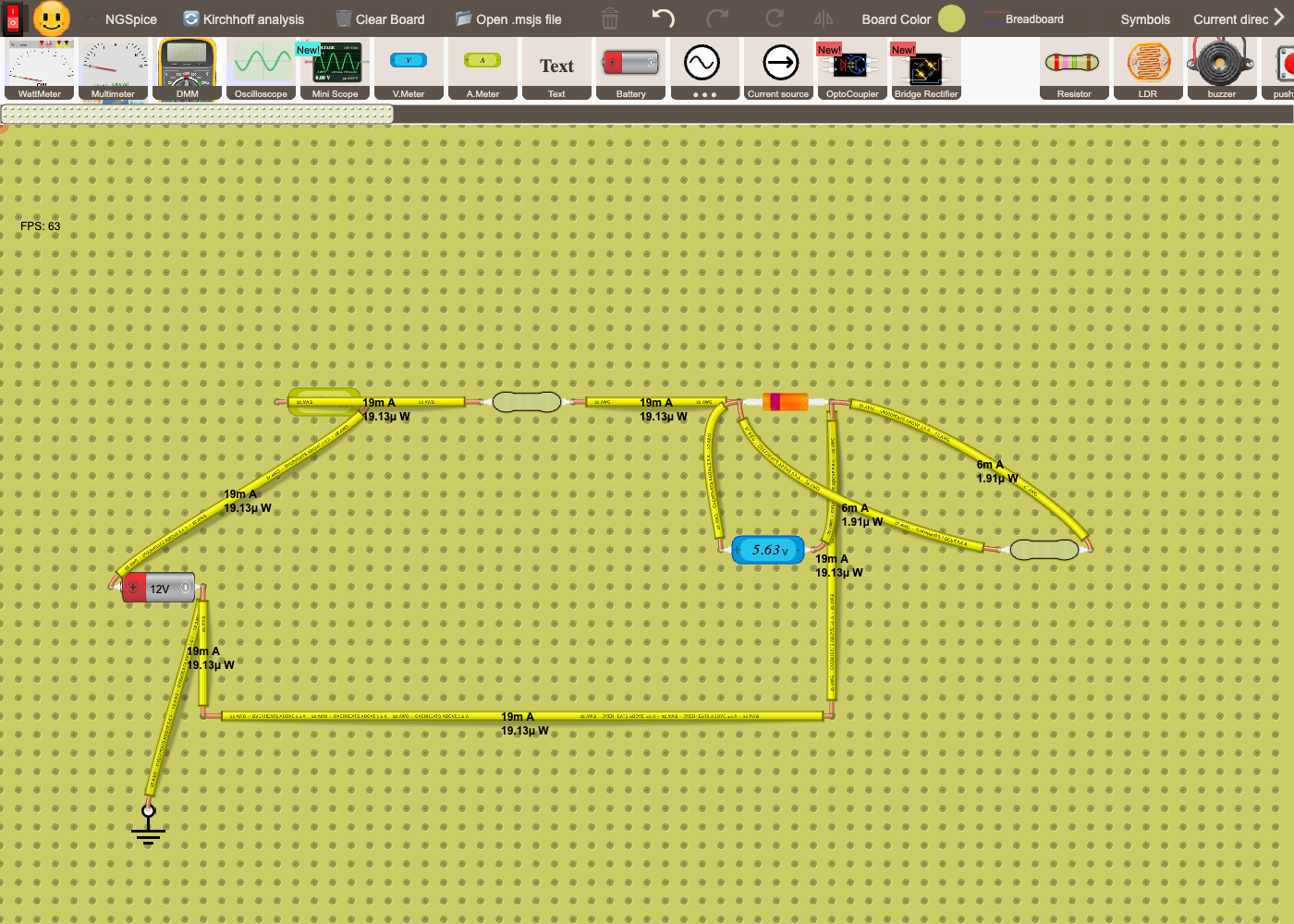
- Read the output: about 5.63 V. The battery gives about 19.3 mA: 5.6 mA to the load, 13.7 mA to the Zener.
- Set the battery to 9 V, then 15 V: the output moves only to about 5.60 V and 5.64 V.
- Click the Zener and change its Zener voltage, 5.6 V by default, settable from 0.1 to 12 V.
- The series resistor is required: it takes the difference between the supply and the Zener voltage.
- The lab's Zener carries 5 mA at its Zener voltage; more current raises the voltage only a little.
- Forward biased, a Zener acts like an ordinary diode.
- A Zener holds a voltage down; it cannot raise a supply below its Zener voltage.
With NGSpice turned on in the full lab, the readings agree: 8.44 mA in the forward bias circuit, 5.63 V at the Zener output.
Rectifiers: from AC to DC
A rectifier uses diodes to turn AC into current that flows one way.
- Half-wave rectifier: one diode passes only the positive half of each cycle. With a 10 V peak, 50 Hz source, a 1 kΩ load and a 100 µF smoothing capacitor, the load reads about 8.6 V.
- Full-wave rectifier with a bridge: both halves of the cycle pass, through two diodes at a time, so two drops are lost and the ripple is at twice the AC frequency, 100 Hz from 50 Hz. A 12 V peak gives about 10.3 V across 1 kΩ and 470 µF.
The bridge rectifier part has its own forward voltage setting, 0.7 V per diode at 10 mA by default, separate from the plain diode's curve.
Diode vs Zener vs LED
- Diode: conducts forward, blocks in reverse.
- Zener diode: conducts forward; in reverse it holds its Zener voltage.
- LED: a diode that lights when it conducts. In the lab it is its own part, and the colour you choose sets its forward voltage.
More diode circuits
Each runs on its own page without an account.
- Diode reverse bias: a diode that blocks – The diode turned round: about 8.99 V across it, no current.
- Half-wave rectifier with a smoothing capacitor – 10 V peak, one diode, 1 kΩ and 100 µF: about 8.6 V.
- Bridge rectifier with a smoothing capacitor – 12 V peak, a bridge, 1 kΩ and 470 µF: about 10.3 V.
- Diode forward and reverse bias lab activity – The diode on an oscilloscope, with a worksheet.
- Half-wave rectifier lab activity – From AC to DC with a filter capacitor.
Use it in class
A diode circuit makes a short assignment: students change one value, read the meters and explain.
- Forward bias: students set the resistor to 100 Ω, 1 kΩ and 10 kΩ and read the drop and the current. Expect about 0.68 V and 83 mA, 0.56 V and 8.4 mA, 0.44 V and 0.86 mA. Ask: why does the current change a hundred times and the voltage so little?
- Zener regulator: students set the battery to 9 V, 12 V and 15 V and read the output and the battery current. Expect the output to stay between about 5.60 V and 5.64 V while the current goes from about 10.3 mA to 28.4 mA; the load takes about 5.6 mA. Ask: where does the extra current go?
The free classroom demo gives you one classroom with room for 30 students for 7 days, counted from when your first student joins (once per teacher); after that it keeps up to 5 students. You sign in first.
Frequently asked questions
Why does a diode drop 0.7 V and not 0?
A silicon junction needs a small voltage before much current flows. In the lab the drop is about 0.56 V at 8.4 mA and 0.68 V at 83 mA; textbooks round it to 0.7 V.
Do I need a series resistor with a diode?
Yes. Once a diode conducts its voltage barely changes, so a resistor has to set the current.
What is the difference between a diode and a Zener diode?
Both conduct forward. In reverse a diode blocks, while a Zener conducts at its Zener voltage and holds it, so it can regulate.
What happens to a Zener regulator when the load changes?
The output stays near the Zener voltage while the Zener takes the current the load does not. A heavier load leaves less for the Zener; once that reaches zero, the output falls.
Why does a bridge rectifier output read lower than the AC peak?
The current passes two diodes on every half cycle, so two drops are lost, and the load drains the capacitor a little between peaks: a 12 V peak gives about 10.3 V in the lab circuit.
Can I simulate a diode free online?
Yes. The circuits on this page run free in your browser, with no account. With a free account the full lab is free to try, then switches to a limited mode.
Does the diode simulator work on a Chromebook?
Yes. DCACLab runs in the web browser, with nothing to install.
Build your own diode circuit
Open the lab and wire a diode, a resistor and a battery yourself, then add meters.
Keep going: How a MOSFET works, with live circuits